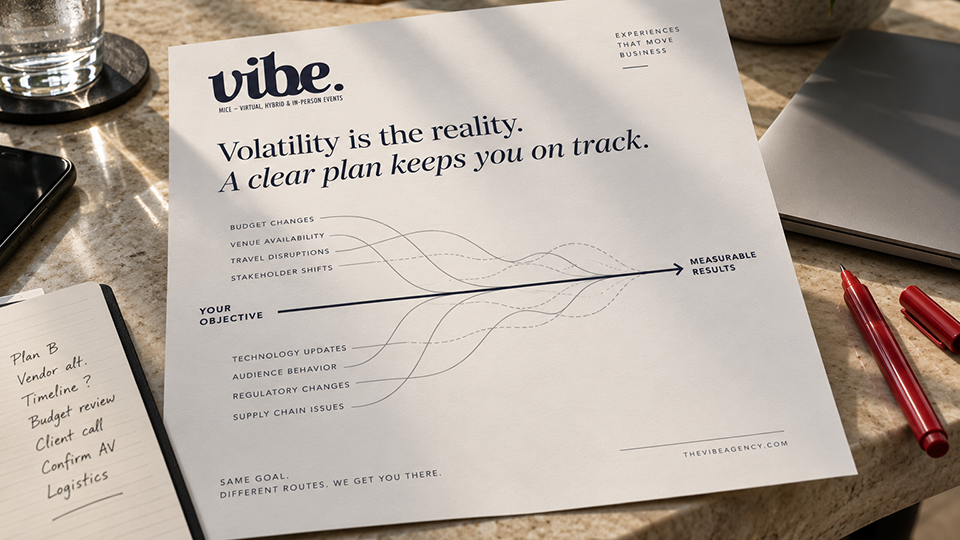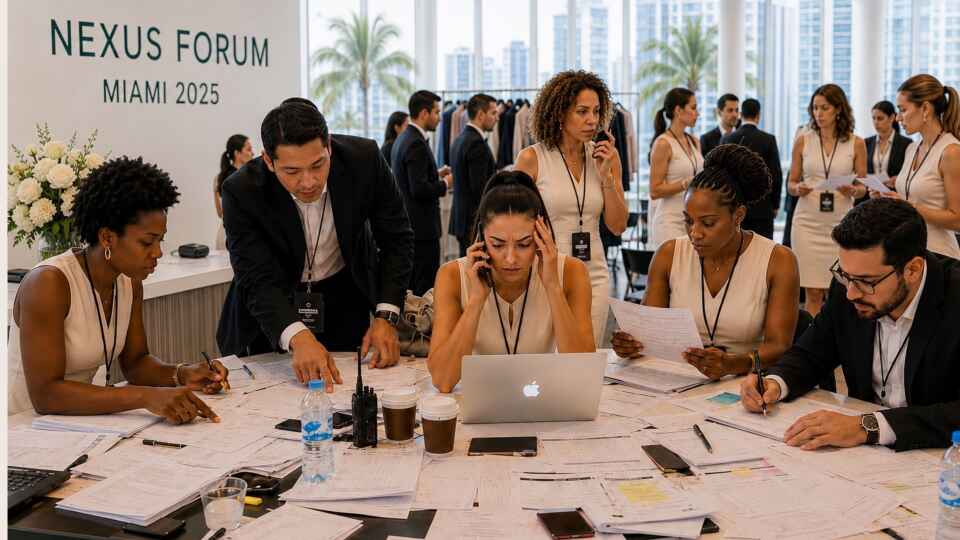
The defining corporate event management challenges in 2026 are cost inflation against flat budgets, uncertain attendance, thinner internal teams, and logistics that break at handoffs rather than at big decisions. Industry data shows 72 percent of planners expect costs to rise while only 36 percent expect budget increases. Fewer events now carry more expectation each.
This is a harder year than the sentiment surveys suggest. Optimism is high in some datasets and worry is rising in others, which usually means the industry is splitting: teams with structure are doing well, and teams without it are absorbing the pressure personally.
Here is where the pressure actually shows up, and where it can be engineered out.
What are the biggest corporate event management challenges right now?
Four dominate. Costs rising faster than budgets. Attendance that cannot be forecast reliably. Internal teams reduced while event volume holds. And a supplier market where the good options go early and response times have slowed.
Northstar Meetings Group’s 2026 forecast projects overall cost increases of 2 to 4 percent, with 38 percent of event professionals expecting cost per attendee to rise. Cvent’s 2026 venue sourcing research, drawn from 1,650 planners, found 72 percent expect costs to rise and 35 percent name staying within budget as their biggest concern.
The attendance question nobody can answer
The data genuinely conflicts, and that is the point.
Northstar reports 40 percent of planners expect attendance to fall by at least 10 percent in 2026. MPI’s Q1 2026 Meetings Outlook, cited by Skift Meetings, reports 60 percent predicting an increase in attendance. Meanwhile GBTA found 56 percent of organizations changed their meetings strategy in the previous three months, including reduced attendance at 24 percent and outright cancellations at 24 percent.
Known fact: forecasts diverge sharply. Our interpretation: attendance has stopped being predictable from history, so it has to be earned per event. The teams holding attendance are the ones inviting earlier, inviting by name, and giving guests a reason that is specific to them. Volume invitations are producing volume declines.
“For thirty years I could tell a client what their attendance would be. Now I tell them what it will depend on. That is not pessimism, it is precision. An invitation that says why this person, this room, this night, still fills a room in any market.”
Valerie Bihet, Founder and CEO, VIBE
Thinner teams, same volume
PCMA’s 32nd Meetings Market Survey captured the operational reality plainly, with 31 percent of event professionals describing themselves as worried heading into 2026, up from 11 percent, and one respondent anticipating a 25 percent staff reduction while carrying the same workload.
That is the quiet challenge behind every other one. Most event failures in 2026 will not be failures of skill or budget. They will be failures of capacity, where a competent person did not have the hours to catch a detail they would normally have caught.
10 reasons corporate event teams hit logistics snags
- The objective was never written down. Without a single stated outcome, every subsequent decision gets made on taste, and taste changes with whoever is in the meeting.
- Sourcing started too late. Cvent’s data shows 88 percent of planners follow a defined sourcing process for at least some meetings, and 97 percent say a structured process saves time and money. The snags cluster in the events that skipped it.
- Nobody owns the seams. Catering knows catering, AV knows AV, and the twenty minutes where guests move between them belongs to no one. That interval is where guest experience is won or lost.
- Headcount was estimated, not tracked. Every downstream number depends on it: catering, transport, seating, staffing, print. A soft headcount held too long forces expensive late decisions.
- Supplier response times were assumed. Cvent found 24 percent of planners name delayed supplier responses as a key obstacle, and 63 percent expect a reply within four business days for smaller events. Build the actual lag into your timeline instead of the ideal one.
- Venue specifications were not verified on site. Load-in access, ceiling height, power, rigging points, and connectivity decide what is possible. Twenty-five percent of planners say researching these specifications is the hardest part of sourcing, and it is regularly done from a PDF.
- The run of show has no rehearsal. Executives, presenters, and transitions get their first attempt in front of the audience. Rehearsal is the cheapest insurance in event production and the first thing cut.
- Contingency was spent early. Contingency exists for the last two weeks, when problems are most expensive. Committing it in month one leaves you negotiating from nothing.
- Accessibility and compliance came in late. Cvent reports 74 percent of planners now prioritize accessibility more than in previous years, and 78 percent say venue sustainability influences sourcing. Both are far cheaper to design in than to retrofit.
- No one owned data capture on the night. The event happens, the guests leave, and the evidence that would have justified next year’s budget was never collected.
How do you prevent event logistics problems?
Write the objective, then protect three things: the date, the headcount discipline, and the rehearsal. Assign a named owner to every handoff between suppliers rather than to each supplier. And treat contingency as untouchable until the final fortnight.
Nine of the ten reasons above are timeline problems wearing a logistics costume.
What changed most for corporate event teams in 2026?
Scrutiny. When only 36 percent of teams expect a budget increase, every event competes internally against everything else marketing or HR could do with the same money. The events that keep getting funded are the ones that arrive at the budget meeting with evidence, not with photographs.
Where to start this week
Take your next event and do three things. Write the objective in one sentence. Set a hard date for headcount lock and hold it. Name one person who owns each supplier handoff. Those three moves remove most of the failure points in the list above, and none of them cost anything.
We have produced more than two thousand corporate events over twenty-two years, and we hold production and destination management under one roof so the handoffs sit inside one team rather than between three vendors. That structure is not a sales point. It is the reason the seams get owned, and the seams are where events actually break.
If your next event is already showing pressure on budget, date, or headcount, send us where it stands and we will tell you what we would fix first.
Frequently Asked Questions
What are the biggest corporate event management challenges in 2026?
Cost inflation against flat budgets, unpredictable attendance, reduced internal teams carrying the same volume, and slower supplier response times. Industry data shows 72 percent of planners expect costs to rise while only 36 percent expect budget increases.
Why do event logistics fail?
Most logistics failures trace to timeline and ownership rather than skill: an objective that was never written down, sourcing started too late, headcount held soft too long, unverified venue specifications, no rehearsal, and no named owner for the handoffs between suppliers.
Is corporate event attendance rising or falling in 2026?
Forecasts conflict. Northstar Meetings Group reports 40 percent of planners expect attendance declines of at least 10 percent, while MPI's Q1 2026 outlook reports 60 percent predicting increases. The practical implication is that attendance now has to be earned per event rather than forecast from history.
How far in advance should corporate events be sourced?
For significant events, begin sourcing six to nine months out, and earlier for peak-season dates or international programs. Cvent reports 97 percent of planners say a structured sourcing process saves time and money, and 42 percent achieve cost reductions of 10 to 30 percent through one.
How much are corporate event costs rising in 2026?
Northstar Meetings Group projects overall increases of 2 to 4 percent, with 38 percent of event professionals expecting slight increases in cost per attendee and 6 percent expecting increases of 11 percent or more.
How do thin internal teams affect event quality?
Capacity failures look like skill failures. When a competent producer carries more events than hours allow, the details that get missed are the small ones nobody has assigned, which is why naming an owner for every handoff matters more than adding headcount.