To build a 2027 corporate event budget that survives review, start with the business outcome rather than the event calendar, price the outcome instead of the room, and attach a measurement plan to every line before the number goes to finance. A budget wins when it can be compared to something. Most event budgets cannot.
Why a flat 2027 event budget is really a cut
September and October are when the number gets set, and the most common outcome is last year’s figure carried forward. That feels safe. It is not.
Costs are moving. Northstar Meetings Group projects event costs rising 2 to 4 percent, and in the American Express Global Business Travel Global Meetings and Events Forecast, more than 70 percent of the 601 meeting professionals surveyed expect costs to increase. Cvent’s survey of 1,650 planners found budget the single biggest concern, named by 35 percent.
Hold the number flat against rising costs and you have not protected the program. You have agreed to a smaller one. The venue list shortens, the production value thins, and the event still has to carry the same expectation it carried last year.
Why event budgets lose the room
Here is the part that stings. Events are not losing the budget argument because finance dislikes them.
Research compiled by Vendelux in 2026 found that 72 percent of marketers rank events as their most effective channel, and 52 percent attribute at least half their closed-won revenue to them. That is not a weak position. It is one of the strongest in the marketing mix.
And yet 86 percent cannot accurately attribute event ROI, and Forrester found 62 percent naming measurement as the specific thing that blocks them from defending their budget. PCMA’s Meetings Market Survey found only 36 percent expecting a budget increase at all.
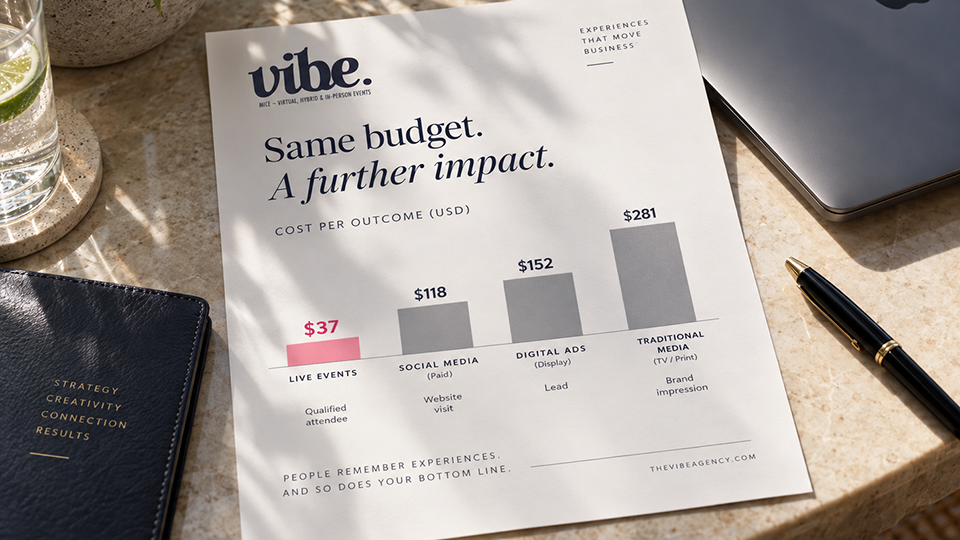
So the channel that closes the most business arrives at the budget meeting as the only line item without a number attached to what it returned. Finance does not cut events because they dislike them. Finance cuts what it cannot compare.
“Every autumn I sit with clients who are certain their event worked, and cannot prove it in a sentence a CFO would accept. Alors, that is not a measurement problem. It is a design problem, and it started the day they booked a room before they named an outcome.”
Valerie Bihet, Founder and Executive Producer, VIBE
We have produced corporate events for more than twenty years, and the teams who keep their budgets are rarely the ones with the best events. They are the ones who decided what the event was for before they decided what it would look like.
How to build a 2027 corporate event budget in five moves
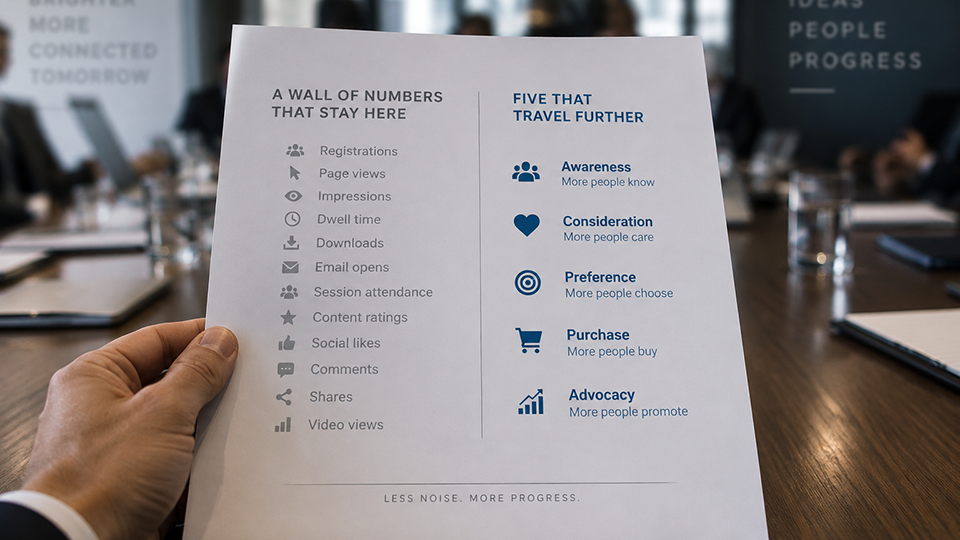
- Name one business outcome per event, before any line item. Pipeline, retention, adoption, recruitment, internal alignment. One. An event asked to do four things well does none of them measurably, and a budget built around four objectives cannot be defended against any of them. This is the same discipline behind aligning event production with business goals.
- Price the outcome, not the room. Build the number from what the outcome requires, then check it against the venue and production market. Teams who start with a venue quote end up defending a room. Teams who start with an outcome end up defending a business case, which is a far easier conversation.
- Fund measurement as a line item, not as goodwill. Capture costs money: the staff time to log conversations on the night, the CRM fields, the follow-up sequence, the survey. Budget it explicitly, at a real number. A measurement plan with no money behind it is a promise, and promises do not survive a busy event week.
- Build a contingency that reflects the market you are buying in. With costs rising 2 to 4 percent and supplier response times stretching, Cvent found 24 percent of planners reporting delayed supplier replies, a thin contingency is optimism dressed as discipline. Name the contingency, justify it with the cost data, and it stops looking like padding.
- Attach a cost per outcome to every event, not just a total cost. Cost per qualified opportunity. Cost per retained account. Cost per trained employee. A total cost invites comparison to last year’s total cost. A cost per outcome invites comparison to your other channels, which is the comparison events win.
What most 2027 budgets leave out
Three costs get missed almost every year, and each one gets absorbed later out of contingency, which is how contingency disappears by March.
The follow-up. The event ends and the work continues for six weeks. Somebody builds the recap, routes the leads, books the meetings. That labor is real and it is almost never budgeted, so it competes with whatever else that team was hired to do.
The content. Photography and video are usually in the budget. The editing, the versioning, and the distribution across the following quarter usually are not, which is how a well-produced event yields four photographs and no campaign.
The second event. If you are running a year-end program and a January kickoff, they draw on the same suppliers and the same internal team. Budgeting them separately costs more and produces a rushed January. Q4 is already full, and the calendar punishes teams who plan those two moments apart.
How to present the number so it survives
Bring one page, not a spreadsheet. The spreadsheet is the backup.
On the page: the business outcome, the three or four metrics that prove it, the total investment, the cost per outcome, and the decision you are asking for. Finance is not evaluating your event. Finance is comparing your number to every other number in the room, and the page that makes comparison easy is the page that gets funded.
Then say what happens if the budget is cut by 20 percent. Not as a threat, as a plan. Naming which outcome you would drop turns a defensive conversation into a strategic one, and it tells the room you understand the business you are asking money from.
Where this leaves your agency choice
If you work with an outside partner, this is the season to ask what they will own. A production partner who quotes a room is selling you a room. A partner who asks what you want the event to change, then prices the capture and the follow-up alongside the staging, is building you something you can defend in January.
Whether you hire us or someone else, insist on that. Ask any agency to show you the measurement line in the budget they propose. If there is not one, the budget you are being handed is a cost estimate, not a business case. Our guide to choosing a corporate event agency covers what else to ask before you sign.
What to do this week
Take your three largest 2027 events and write one sentence for each: what this event is for, and how we will know. If you cannot finish the sentence, the budget for that event is not ready, and no amount of detail in the spreadsheet will fix it.
Then add the measurement line. It is the cheapest item in the budget and the only one that protects the rest of it.
If you want your 2027 event budget pressure tested before it goes to finance, we will read it with you and tell you where it will get challenged.
Frequently Asked Questions
When should we set our 2027 corporate event budget?
September and October, alongside the wider annual planning cycle. Setting the event number after the departmental budget is fixed leaves you negotiating for what is left rather than making the case for what the program needs.
How much should a corporate event budget increase for 2027?
Plan for cost increases before program changes. Northstar Meetings Group projects event costs rising 2 to 4 percent, and more than 70 percent of professionals in the Amex GBT forecast expect costs to rise, so a flat budget means a reduced program.
Why do event budgets get cut even when events perform well?
Because performance is rarely proven in comparable terms. Vendelux reports 86 percent of marketers cannot accurately attribute event ROI, and Forrester found 62 percent say measurement is what stops them defending their budget. Finance cuts what it cannot compare.
What should be included in a corporate event budget that usually is not?
Three things: the post-event follow-up labor, the editing and distribution of event content across the following quarter, and the measurement itself. All three get absorbed by contingency later if they are not named early.
What is a good way to measure corporate event ROI?
Set one business outcome per event, translate it into three or four metrics with a named owner for each, build the capture into the run of show rather than the recap, and report a cost per outcome rather than a total cost.
Should we budget our year-end event and January kickoff together?
Yes. They fall weeks apart and draw on the same venues, suppliers, and internal team. Budgeting them as one program secures both calendars, reduces cost through shared logistics, and prevents the January event from being assembled over the holidays.