Corporate event KPIs are the small set of business measures an event is accountable for, usually three to five, chosen before the event is designed. The useful ones track pipeline, retention, adoption, capability or advocacy. Attendance, satisfaction scores and social impressions are metrics, not KPIs, because no executive makes a decision from them.
What is the difference between an event KPI and an event metric?
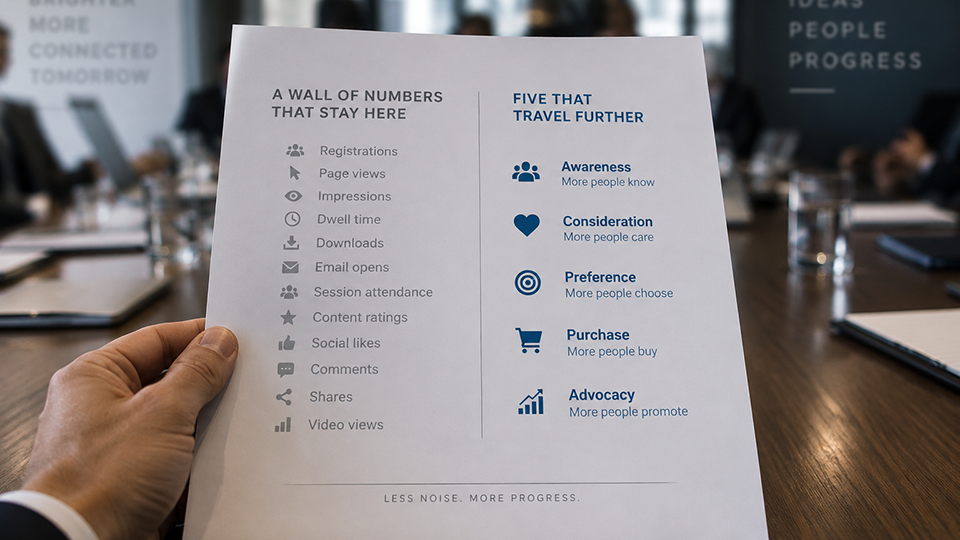
A metric is anything you can count. A KPI is the number that changes a decision.
Registrations, show rate, session dwell time, app downloads, net promoter score, impressions: all real, all countable, none of them a reason to fund the program again. They describe the event. A KPI describes what the event did to the business.
The distinction matters because most teams report metrics and then wonder why the budget conversation goes badly. Research compiled by Vendelux found 72 percent of marketers rank events as their most effective channel and 52 percent attribute at least half their closed-won revenue to events, yet 86 percent cannot accurately attribute event ROI. Forrester found 62 percent naming measurement as the specific thing that blocks them from defending their budget.
That gap is not a reporting failure. It is a selection failure. The wrong things were chosen to measure, and they were chosen too late.
“I have watched a client present a ninety percent satisfaction score to a CFO who then cut the budget anyway. Alors, of course he did. She told him people enjoyed it. She did not tell him what it was worth.”
Valerie Bihet, Founder and Executive Producer, VIBE
The five event KPIs that actually travel to the business
- Influenced pipeline. The value of opportunities created or advanced within a defined window after the event, usually 60 or 90 days. Agree the attribution rule with sales before the event, not after. A rule everyone signed up to in advance beats a more sophisticated rule invented in the recap.
- Retention or renewal rate among attendees. Compare renewal among invited clients who attended against a matched group who did not. This is the single most under-used event KPI, and for client events it is usually the truest one.
- Adoption or capability change. For user conferences, training events and kickoffs: the measurable behaviour you wanted. Feature activation, certification completion, method in use by a date. Measure it at 30 and 90 days, not on the night.
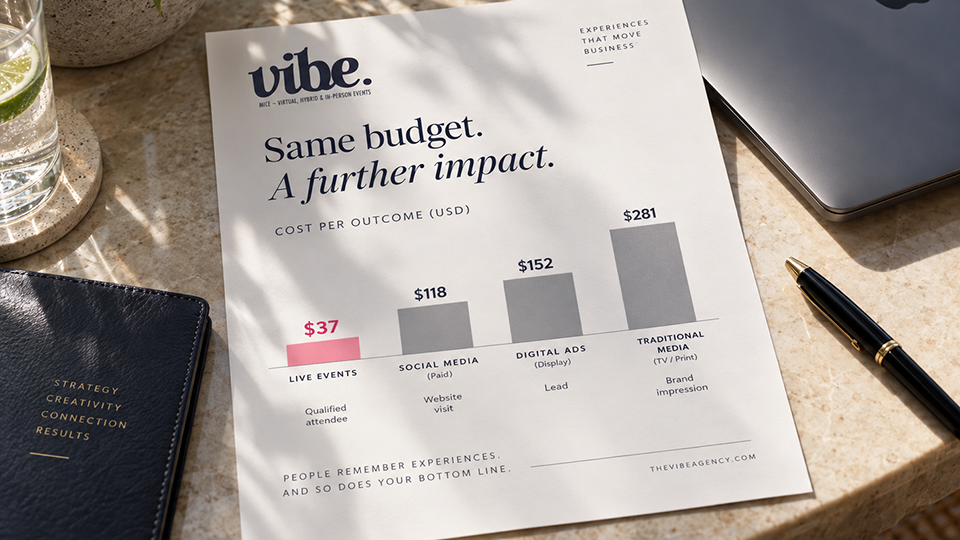
- Cost per outcome. Cost per qualified opportunity, per retained account, per trained employee. A total cost invites comparison to last year’s total cost. A cost per outcome invites comparison to your other channels, which is the comparison events win.
- Advocacy that can be counted. Referrals made, references agreed, case studies approved, speaking slots accepted. Not sentiment. Named actions by named people, logged in the CRM.
Event KPIs by event type
The right KPI depends on what the event is for. These are the defaults we start from.
Sales kickoff. Time to first deal for new hires, pipeline created in the following quarter, and message adoption measured by how many reps use the new positioning in live calls within 30 days.
Client or hospitality event. Renewal rate among attendees versus non-attendees, meetings booked within 30 days, and expansion conversations opened. See designing a client event around the business moment for how to build that capture into the night itself.
User conference or customer summit. Feature adoption at 90 days, support ticket volume change, renewal among attendees, and reference commitments secured.
Incentive travel. Retention of qualifiers at 12 months, performance change among qualifiers versus near-misses, and qualification rate the following year. Detail in building an incentive program that keeps top performers.
Trade show or exhibition. Qualified conversations per staff day, cost per qualified opportunity, and pipeline influenced. Badge scans are a metric.
Internal town hall or leadership meeting. Decision velocity on the items raised, and alignment measured by whether the priorities named appear in team plans within 30 days.
How many KPIs should one event have?
Three to five. Never more.
An event asked to prove six things proves none of them well, because the capture required for each one competes for the same staff, the same minutes and the same guest patience. Pick one primary KPI that the event is genuinely accountable for, and two to four supporting measures that explain the primary one.
If your list has more than five, you have not made a choice yet. You have written a wish.
Which event KPIs should you ignore?
Not ignore exactly. Demote.
Attendance is an input, not a result. Northstar Meetings Group found 40 percent of planners expecting attendance to fall by at least 10 percent, so a program judged on headcount is judged on a number the market is moving for you.
Satisfaction scores measure whether the event was pleasant. Useful for the production team, close to worthless in a budget meeting.
Impressions and reach measure exposure, not effect, and they are the easiest number in the deck to inflate.
Report them if you like. Just never lead with them, and never make one the KPI the program is defended on.
How do you actually capture event KPIs?
Capture is designed, not remembered. Three rules make it work.
Name an owner per KPI before the event. Not a team, a person. An unowned metric is an unmeasured one.
Build the capture into the run of show. Fifteen minutes for hosts to log conversations while the detail is fresh beats a survey nobody answers. The follow-up sequence is written before the doors open, not after.
Fund it. Capture costs staff time, CRM fields and follow-up labour. Put it in the budget as a line item. It is almost always cheaper than the item you would cut it for, and it is the only line that protects the rest of them. That case is made in full in building a 2027 event budget you can defend.
What to ask an event partner about measurement
Ask any agency, ours included, to show you the measurement line in the budget they propose, and to name which KPI each element of the program serves.
If a proposal cannot connect the welcome reception to a KPI, either the reception has a purpose nobody wrote down or it does not have one. Both are worth knowing before you pay for it. Whether you hire us or someone else, insist on that mapping. Our guide to choosing a corporate event agency covers the rest of that conversation.
Where to start this week
Take your next event and write three lines. What this event is accountable for. The one number that proves it. The person who owns that number.
If you can write those three lines, you have a KPI framework. If you cannot, no dashboard will save the budget conversation in January.
If you want your event KPIs defined and agreed with sales and finance before you design anything, we will build the framework with you.