To align event production with business goals, name one business objective before any creative decision, translate it into three or four metrics you can actually capture, build the capture into the run of show rather than adding it afterward, and agree the reporting format with your finance partner before you spend. Design follows the objective. Never the reverse.
Most events are misaligned at the moment they are conceived. Someone approves a format, a date, and a budget. The objective arrives later, reverse engineered to justify a decision already made. Then the recap deck measures attendance and social impressions, because those are the only numbers anyone captured.
That is not a measurement problem. It is a sequencing problem.
Why most events fail to prove business value
The gap is well documented. Research from HockeyStack found 72 percent of marketers rank events as their company’s most effective marketing channel, and 52 percent attribute at least half of their closed-won deals to events. Yet Vendelux’s 2026 survey reports 86 percent cannot accurately attribute ROI back to those events, and Forrester found 62 percent of marketers name ROI measurement as the single biggest barrier to defending their event budget.
Read those numbers together. Events are the channel that works and the channel that cannot prove it works. In a year when PCMA reports only 36 percent of event professionals expect budget increases, that gap is expensive.
Known fact: the attribution gap is industry-wide. Our interpretation: it persists because measurement is treated as a reporting task assigned after the event, when it is actually a design constraint that belongs in the first meeting.
How to align event production with business goals: start with one objective
An event can serve several outcomes. It can only be designed around one.
Pick the single business result the event exists to create. Pipeline. Renewal. Product adoption. Internal alignment. Retail traffic. Recruitment. Then write it as a sentence a CFO would recognize: “This event exists to move forty target accounts from stalled to active conversation.”
Everything downstream becomes easier. The guest list is now a filter, not an invitation blast. The room layout serves conversation rather than sightlines. The follow-up is designed before the invitation goes out.
“Every client tells me their event has five objectives. Then I ask which one they would keep if we could only deliver one, and the real answer comes out in four seconds. That answer is the brief. The other four are hopes, and hopes do not survive a floor plan.”
Valerie Bihet, Founder and CEO, VIBE
How to turn a business goal into event metrics
Translate the objective into three or four metrics, no more, and confirm each one can be captured on the night. A metric you cannot capture is a wish.
- Pipeline objective. Measure qualified conversations held, meetings booked on site, opportunities created within thirty days, and influenced pipeline value. Capture through a staffed booking mechanism during the event, not an email afterward.
- Client retention objective. Measure attendance rate among named target accounts, executive-to-executive conversations completed, and renewal conversations advanced within sixty days. Attendance by name matters more than total headcount.
- Product adoption objective. Measure demonstrations completed, trial or sample activations, product-specific questions logged, and post-event usage lift. Build the demo into the flow so it is unavoidable rather than optional.
- Internal alignment objective. Measure pre and post sentiment on two or three specific statements, participation in working sessions, and manager-reported clarity thirty days out. Ask the same question before and after or you have no delta.
- Brand and visibility objective. Measure earned coverage in target publications, share of attendee content, and message recall in a short post-event survey. Impressions alone will not defend a budget.
Cvent’s 2026 Planner Sourcing Report, based on 1,650 planners, found 63 percent name attendee engagement as their primary success metric. Engagement is a useful signal. It is not a business outcome. Pair it with one number your finance partner already tracks.
Build capture into the run of show
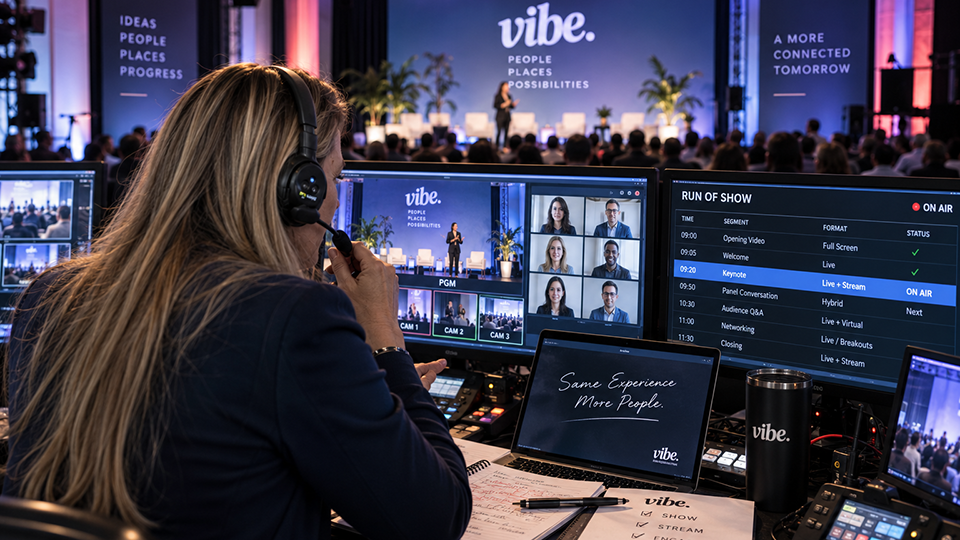
This is the step almost everyone skips. If your metric is meetings booked, someone owns booking meetings, in a specific place, at a specific time, with a specific tool. If your metric is message recall, the survey is written before the event and triggered within twenty-four hours while memory is intact.
Assign each metric an owner and a moment on the run of show. Unowned metrics do not get captured, and data that was not captured on the night cannot be recovered later.
What should you report to leadership after an event?
Report four things in one page: the objective as written before the event, the metrics against it, the cost per outcome, and the specific decision you are asking for next. Attach the evidence, do not lead with it.
Leadership is not evaluating your event. They are deciding whether to fund the next one. Write the page that answers that question.
Where events and business goals most often disconnect
The disconnect is usually one of four things. The objective was set after the format. The metrics measured activity instead of outcome. Nobody owned capture on site. Or the follow-up was designed after guests had already gone home, which is roughly a week too late to matter.
Fix the sequence and most of the measurement problem dissolves.
Where to start this week
Take your next event and write one sentence: what this event exists to change. Then name three metrics and assign each one an owner and a moment in the run of show. If any metric has no owner and no moment, it is not a metric yet.
We design events backward from the business result, which is why our proposals name the measurement plan before the creative concept. It is a less exciting first page. It is the reason our clients can fund the next event.
If you have an event on the calendar without a measurement plan, send us the objective and we will map the metrics and the capture points with you.
Frequently Asked Questions
How do I align event production with business goals?
Name one business objective before any creative or format decision, translate it into three or four capturable metrics, assign each metric an owner and a moment in the run of show, and agree the reporting format with your finance partner before you spend.
How do you measure event ROI?
Compare the business outcome the event was designed to produce against total landed cost, using metrics captured during the event itself: meetings booked, qualified conversations, opportunities created within thirty days, influenced pipeline, or measured sentiment change. Attribution requires capture built into the event, not reconstructed afterward.
What KPIs should we use for a corporate event?
Choose three or four tied to your single objective. Pipeline events use meetings booked and opportunities created. Retention events use named-account attendance and renewal conversations advanced. Internal events use pre and post sentiment on specific statements. Attendance and impressions are context, not KPIs.
Why can't most companies prove event ROI?
Because measurement is treated as post-event reporting rather than a design constraint. Research indicates 86 percent of marketers cannot accurately attribute ROI to events, largely because the data was never captured during the event and cannot be recovered later.
When should we decide how to measure an event?
Before the format, the venue, or the creative. The metrics determine the design: a pipeline objective changes the guest list and the floor plan, and a sentiment objective requires a baseline survey before invitations go out.
How do I present event results to executives?
One page, four elements: the objective as written before the event, performance against the agreed metrics, cost per outcome, and the specific decision you need next. Supporting evidence goes in an appendix.