Every corporate event needs seven roles filled, whether by one person or fifteen: business sponsor, event lead, producer, technical director, content lead, logistics lead, and measurement owner. The roles do not scale with budget. The number of people covering them does. Events fail when a role is assumed rather than assigned, and the measurement owner is the one most often left empty.
What roles are needed to run a corporate event?
Seven, and they are functions rather than job titles. A 60 person leadership offsite might have three people covering all seven. A 2,000 person user conference might have thirty. What does not change is that every one of the seven has to be somebody’s job.
The failure mode is not understaffing. It is ambiguity. When two people believe someone else owns the run of show, nobody does, and the gap is discovered on the day.
“I do not ask a client how many people they have. I ask them to say each role out loud and name the person. The silences tell me exactly where the event will go wrong. Alors, we fix it in that meeting, not in the venue.”
Valerie Bihet, Founder and Executive Producer, VIBE
The seven key roles in corporate event production
- Business sponsor. Owns the objective and the budget, and is the only person who can change what the event is for. Usually a senior leader outside the event team. If nobody holds this role, the event has no defence in budget season, which matters when Forrester found 62 percent of marketers say measurement is what blocks them defending event budgets.
- Event lead. Owns the brief, the budget in practice, the supplier relationships and the internal politics. The single point of contact for the business. This is the role most likely to be doing three other jobs as well.
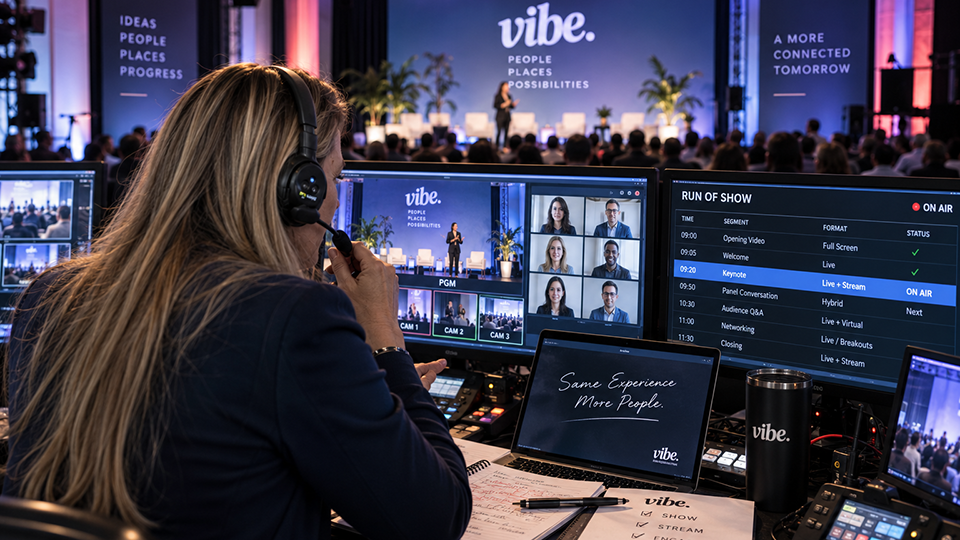
- Producer. Owns the run of show and everything that happens between doors open and doors close. On the day, the producer outranks everyone, including the people who outrank them the rest of the year. That authority has to be granted explicitly, in advance, in front of the group.
- Technical director. Owns audio, video, lighting, staging and, for hybrid, the stream. Names the failure modes and the redundancy. For a hybrid event, ask specifically who directs the stream, since that is where the seam between two audiences sits. More on that in how to compare hybrid event partners.
- Content lead. Owns the narrative, the speakers, the rehearsal and the deck. Separate from the producer for a reason: one person cannot simultaneously fix a keynote and fix a room. When these merge, the content is what quietly loses.
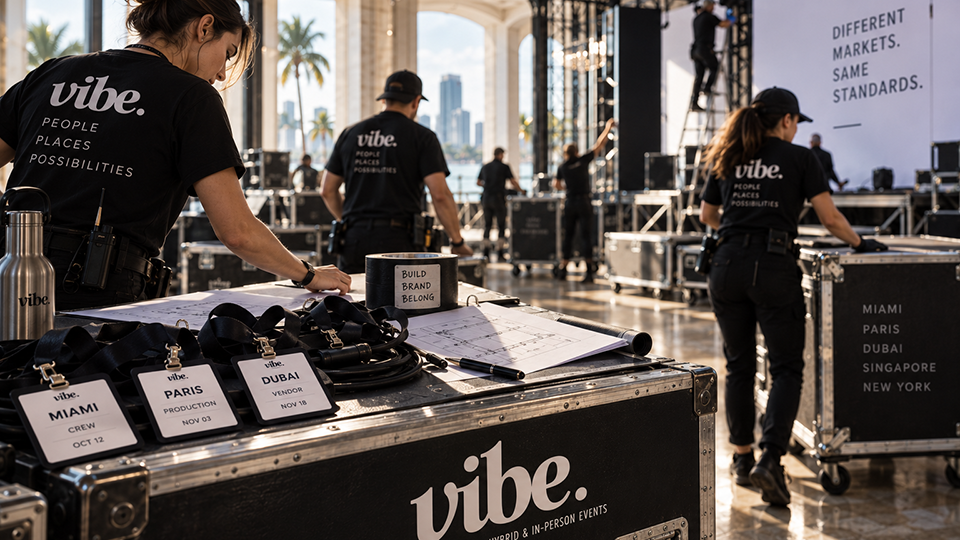
- Logistics lead. Owns travel, rooming, catering, registration, transport and the hundred details guests notice only when they are wrong. The least glamorous role and the one guests feel most directly.
- Measurement owner. Owns the capture plan, the data on the night and the report afterwards. This is the role most often left unfilled, which is why Vendelux reports 86 percent of marketers cannot accurately attribute event ROI. See corporate event KPIs for what this person should be capturing.
Which roles can one person hold at once?
Some combinations work. Others reliably fail.
Safe to combine. Event lead and logistics lead, on smaller programs. Content lead and measurement owner, since both think in outcomes.
Combine with caution. Producer and technical director, only if the technical scope is genuinely simple and there is no stream.
Do not combine. Producer and content lead, because both need full attention during the same hours. Business sponsor and event lead, because the person defending the budget should not be the person who built it, or the review has no independence.
Never leave empty. The measurement owner. If nobody else can hold it, the business sponsor should, since they are the one who will need the number.
Who should own what on the day?
One producer, with authority granted in advance and in public.
Say it in the final planning meeting, with the senior people present: on the day, the producer’s call is final. Without that sentence, every incident becomes a negotiation, and negotiations take minutes that events do not have.
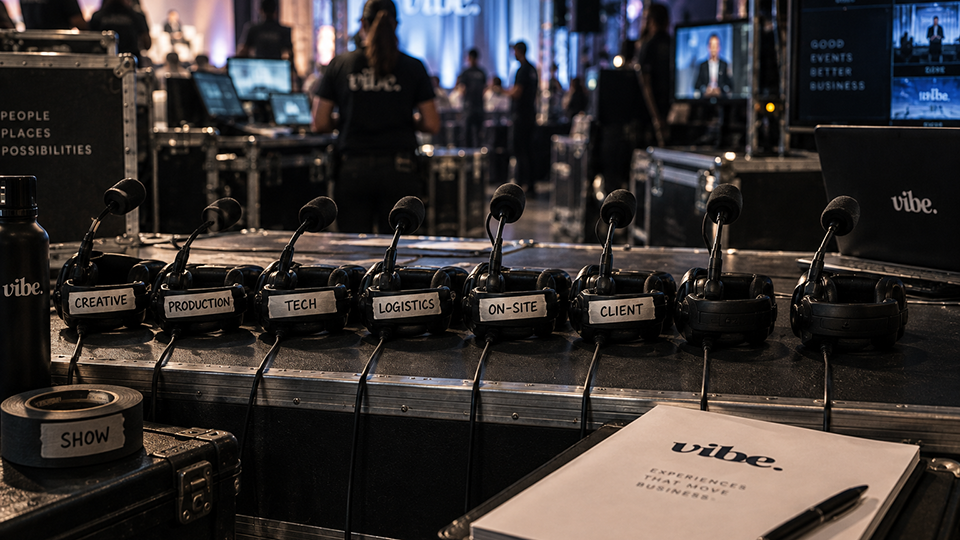
Everyone else gets one job and a radio. The most common on-site failure is a senior person improvising a change without telling the producer, which is a role clarity problem rather than a personality one.
How do agency roles and client roles fit together?
Pair them. For each of the seven, name the client person and the agency person, then say which one decides.
Most friction between clients and agencies traces to two people believing they own the same role. The fix takes fifteen minutes and belongs in the kickoff, not in a document nobody reads.
Whether you work with us or another agency, insist on that pairing at kickoff, and ask which of the seven roles the agency is actually taking. An agency that claims all seven is either very good or has not read the list. Our guide to choosing a corporate event agency covers what else to establish before you sign, and corporate event workflows covers the process these roles run.
Where to start this week
Open your next event and write the seven roles in a column. Put a name against each one, first names are fine.
The empty rows are your real risk register. Fill them before you do anything else, and expect the measurement owner row to be the hard one.
If you want your event team structure reviewed against the roles your program actually needs, we will map it with you.
Frequently Asked Questions
What are the key roles in corporate event production?
Seven: business sponsor, event lead, producer, technical director, content lead, logistics lead, and measurement owner. They are functions rather than job titles, and every one has to be assigned to a named person even on a small event.
What does an event producer do?
The producer owns the run of show and everything between doors open and doors close. On the day the producer's call is final, and that authority should be granted explicitly and in public during the final planning meeting.
Can one person do multiple event roles?
Yes, with limits. Event lead and logistics lead combine well on smaller programs, as do content lead and measurement owner. Producer and content lead should not be combined, because both require full attention during the same hours.
Who owns event measurement?
A named measurement owner, responsible for the capture plan, the data collected during the event, and the report afterwards. This role is the one most often left empty, which is why so few teams can attribute event ROI.
How do client and agency roles work together on an event?
Pair every one of the seven roles with a client person and an agency person, and state which of the two decides. Most client and agency friction comes from both sides believing they own the same role.
How many people do you need to run a corporate event?
As many as it takes to cover seven roles without leaving one empty. A small offsite may need three people; a large conference may need thirty. Understaffing is rarely the problem. Unassigned roles are.