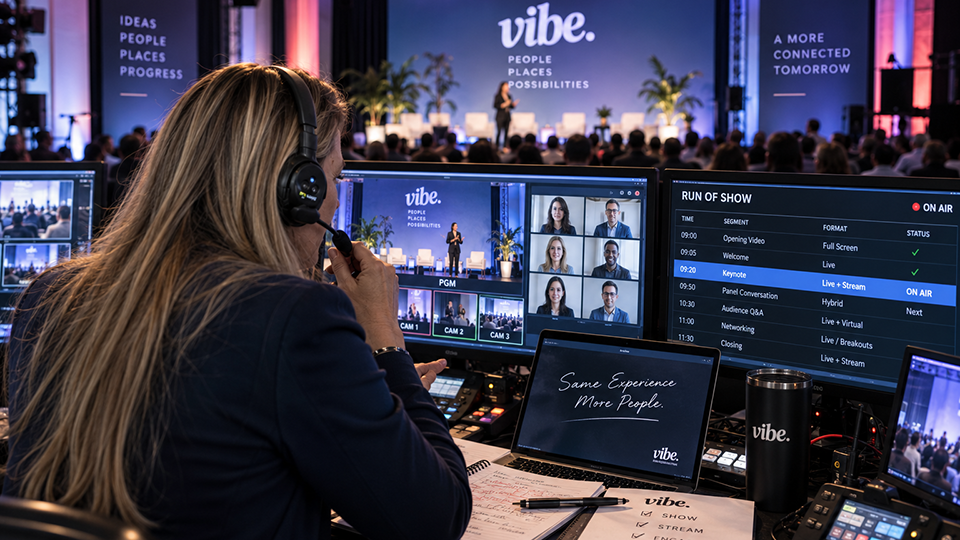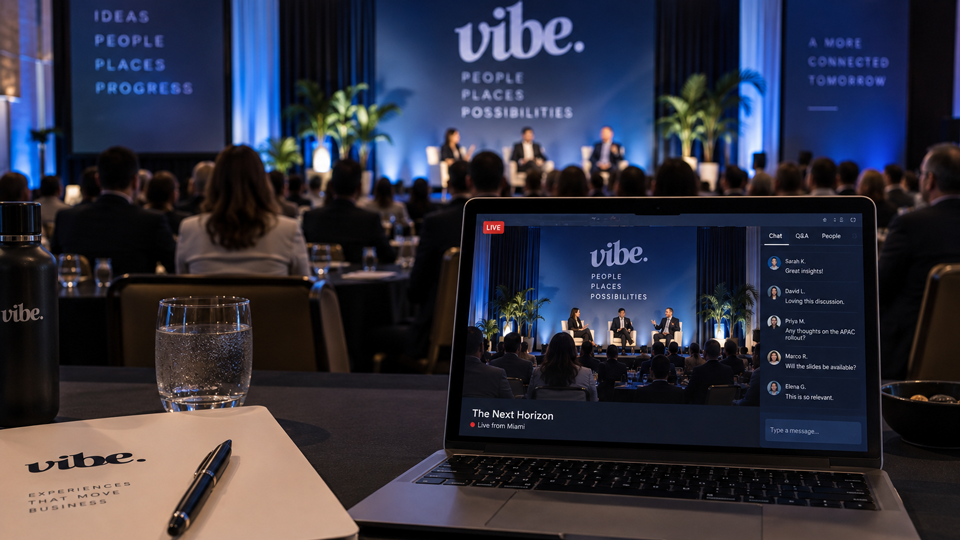
The hybrid event risks that actually damage programs are rarely technical. They are a remote audience nobody owns, a run of show written for the room, engagement measured by view counts, a rehearsal that skipped the real speakers, and a follow-up that treats remote attendees as a lesser list. The stream failing is the risk teams prepare for. It is not the one that costs them.
What is the biggest hurdle in running a hybrid event?
Attention, not bandwidth.
A person in the room has committed their day. A person on a stream has committed a browser tab, and is one notification away from leaving. Those are different levels of consent, and a program that ignores the difference loses the remote audience in the first fifteen minutes, quietly, without a single technical fault.
This is why hybrid events so often feel successful in the room and register as nothing afterwards. Half the audience was never really there.
Why are hybrid events harder to run in 2026 and 2027?
Because most of them are being decided under pressure rather than designed.
The Global Business Travel Association surveyed 539 buyers and suppliers in late March and early April 2026 and found 56 percent had changed their meetings or events approach within the previous three months, with 26 percent shifting gatherings to virtual and 24 percent reducing how many employees attended. Meanwhile PCMA’s Meetings Market Survey found 28 percent expecting virtual attendee numbers to grow, up from 15 percent.
So the remote audience is getting larger while the decisions that create it are getting faster. That combination produces hybrid events that were converted rather than conceived.
“The stream is never the problem. The problem is that nobody in the room is thinking about the people who are not in it. Alors, I ask for one person whose only job is the remote audience. Give me that and most of the risks disappear.”
Valerie Bihet, Founder and Executive Producer, VIBE
The seven hybrid event risks teams miss
- Nobody owns the remote audience. Everyone owns the event. No single person is accountable for whether the people at home had a good one. Name that person, give them authority over the run of show, and let them stop the show if the stream side is failing.
- The run of show is written for the room. Applause, room questions, table exercises and networking breaks all read as dead air on a stream. Build parallel content for those windows, or shorten the broadcast so it does not include them.
- Engagement is measured by views. A view is not attention. Define what an engaged remote attendee actually did, whether that is a question asked, a poll answered, a resource downloaded, and count that instead. Corporate event KPIs covers how to set that properly.
- Rehearsal happened without the real speakers. A technical check with stand-ins proves the equipment works. It does not prove your CEO knows where to look, or that the slide deck reads on a laptop screen. Rehearse with the actual people, on the actual platform.
- The camera plan assumes a stage. Speakers wander, panels turn inward, and the screen the room can see is often illegible on a stream. Decide in advance what the remote audience sees during every segment, including the segments where nothing is happening on stage.
- Accessibility is treated as an add-on. Cvent’s survey of 1,650 planners found 74 percent citing accessibility as a factor in venue and event decisions. Captions, transcripts and a platform that works with a screen reader are part of the build, not a request to handle later.
- The follow-up ignores half the audience. The room gets a handshake and the stream gets an automated email. Remote attendees are often the ones who could not travel, which frequently means the ones with the least existing relationship. Design their follow-up first, not last.
What is the most common hybrid event failure?
Treating the stream as a broadcast of an event rather than as an event.
A broadcast points a camera at something designed for other people. An event gives its audience something to do. The single highest-return change most teams can make is to give the remote audience one active moment in the first ten minutes: a question they answer, a choice they make, a poll that visibly changes what happens next.
That one moment converts a viewer into a participant, and participants stay.
How do you reduce hybrid event risk without doubling the budget?
Three moves, none of them expensive.
Shorten the broadcast. You do not have to stream everything. A tighter, well produced 90 minutes beats a full day of a camera watching a room. It also cuts crew hours.
Assign the remote owner from your own team. This costs nothing and removes the most common failure mode on the list.
Fund captions and a proper platform before you fund a second camera. Accessibility and stability affect every remote attendee. A second angle affects the polish.
Whether you work with us or another agency, insist on a named remote owner and a rehearsal with real speakers. If a proposal contains neither, the risk has not been removed. It has been left with you. Why hybrid events are not dead covers when the format is the right call in the first place, and how to compare hybrid event partners covers who should run it.
Where to start this week
Take your next hybrid event and answer one question: who is accountable for the experience of the people who are not in the room, and do they have the authority to change the agenda?
If the answer is nobody, or somebody without authority, that is the risk to fix first. Everything else on this list is cheaper once it is solved.
If you want your hybrid run of show reviewed for the risks that do not show up until the day, we will read it with you.
Frequently Asked Questions
What are the biggest hybrid event risks?
An unowned remote audience, a run of show written only for the room, engagement measured by view counts, rehearsal without the real speakers, a camera plan that ignores dead air, accessibility handled late, and follow-up that treats remote attendees as a secondary list.
What is the most common hybrid event mistake?
Treating the stream as a broadcast of an event rather than as an event. A broadcast points a camera at something built for other people. Giving the remote audience one active moment in the first ten minutes is the highest-return fix available.
Who should own the remote audience at a hybrid event?
One named person, from your team or your agency, whose only responsibility is the experience of people not in the room, with the authority to change the run of show if the remote side is failing.
How do you measure hybrid event engagement?
Define what an engaged remote attendee actually did, such as asking a question, answering a poll or downloading a resource, and count that. Stream views measure exposure, not attention, and they are the easiest number to inflate.
Do hybrid events need captions and accessibility features?
Yes, and they belong in the build rather than added late. Cvent's survey of 1,650 planners found 74 percent citing accessibility as a factor in event and venue decisions.
Why are more events going hybrid in 2026 and 2027?
Frequently under pressure. The GBTA found 56 percent of buyers changed their meetings approach within three months and 26 percent shifted events to virtual, while PCMA found 28 percent expecting virtual attendance to grow, up from 15 percent.