To compare hybrid event partners, judge six things: a single accountable producer across both audiences, in-house or contracted technical direction rather than a subcontracted unknown, evidence of running your scale, a measurement plan that counts the remote audience properly, redundancy you can see, and a rehearsal discipline. Most agencies can stage a room. Fewer can run two rooms at once.
What makes a hybrid event partner different from an event agency?
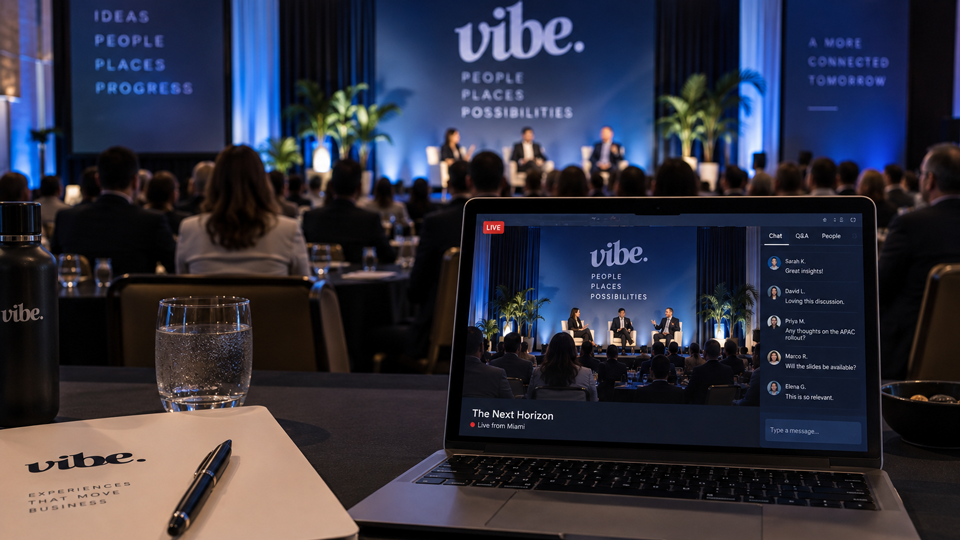
A hybrid event has two audiences with different needs, sharing one run of show. That is not a production add-on. It is a second event, running simultaneously, on infrastructure that fails differently.
The room forgives a ten second pause. The stream does not. A speaker who walks out of frame is invisible to half the audience. A questions segment designed for the floor leaves remote attendees watching other people talk.
So the comparison is not about who has better cameras. It is about who has run the thing before, at your size, with the same stakes, and can tell you what went wrong last time.
“Everyone will tell you they do hybrid. Ask them who directed the stream, by name, and what they did when the feed dropped. Bref, the honest ones have a story ready. The others start talking about equipment.”
Valerie Bihet, Founder and Executive Producer, VIBE
Why is this comparison harder in 2026 and 2027?
Because hybrid stopped being a plan and became a reaction.
The Global Business Travel Association surveyed 539 buyers and suppliers between 25 March and 8 April 2026 and found 56 percent had changed their meetings or events approach within the previous three months. Twenty six percent shifted gatherings to virtual. Those were rarely designed decisions. They were responses to a budget or a travel constraint.
PCMA’s Meetings Market Survey found 28 percent expecting growth in virtual attendees, up from 15 percent. So the remote audience is growing while the decision to serve it is being made under pressure. That is exactly the condition in which teams pick a partner badly.
The six criteria for comparing hybrid event partners
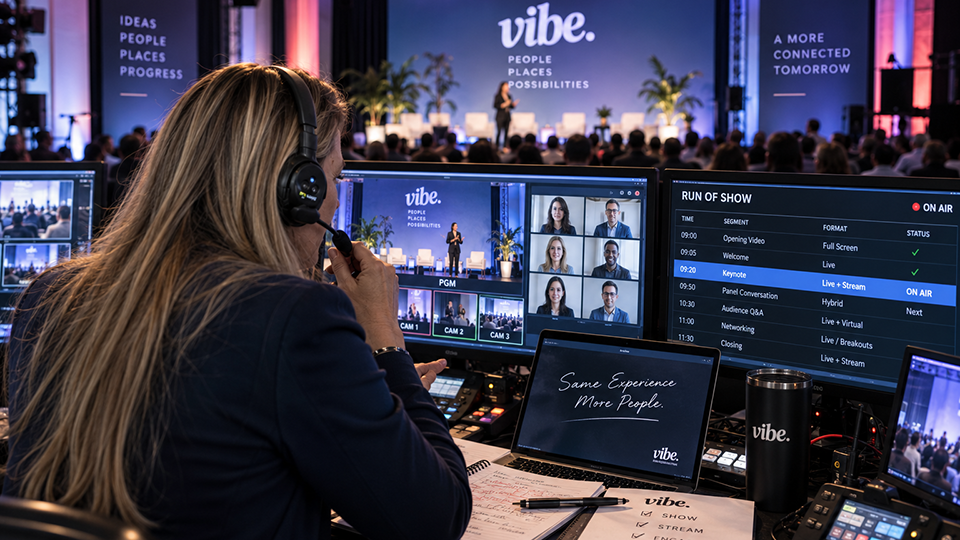
- One accountable producer, named in the proposal. Not an account team, a person, responsible for both the room and the stream. Hybrid failures almost always happen in the seam between two vendors who each did their part correctly. Ask who owns the seam.
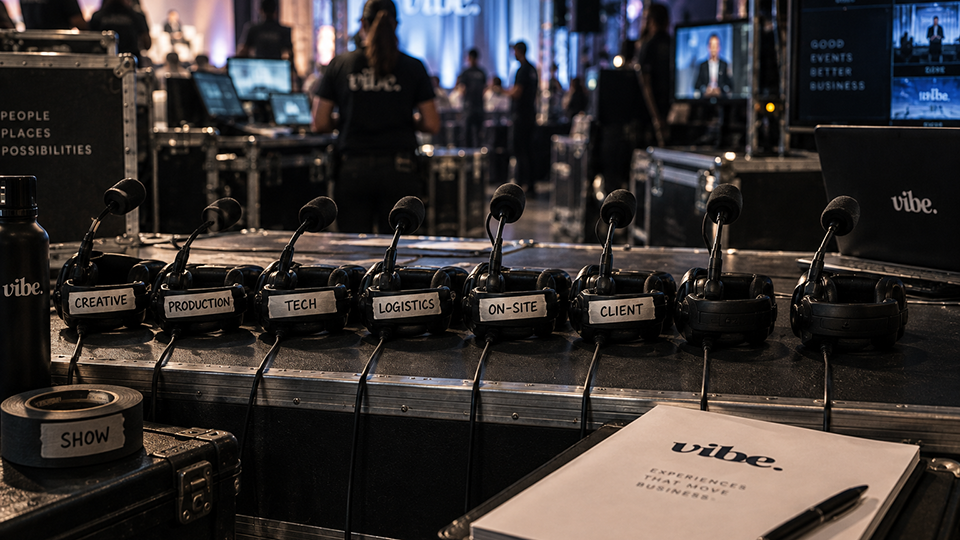
- Technical direction you can meet before you sign. Ask whether streaming is in-house or subcontracted, and if subcontracted, to whom. You are entitled to meet the person who will call the shots on the day. A partner who will not introduce them is telling you something.
- Evidence at your scale and in your format. A 200 person town hall and a 2,000 person user conference are different problems. Ask for two references at your size, in your format, and ask those references what broke.
- A measurement plan that counts the remote audience honestly. Most hybrid reporting flatters the stream, because a view is easy to count and easy to inflate. Ask how they define an engaged remote attendee and what they will capture for each audience. If the answer is view counts, the measurement is decorative. Our guide to corporate event KPIs covers what to ask for instead.
- Redundancy you can actually see. Backup encoder, backup internet path, backup power, and a documented decision rule for when to switch. Ask what triggers the switch and who makes that call. A partner with redundancy will answer in one sentence.
- Rehearsal treated as production, not as a courtesy. A technical rehearsal with the real speakers, on the real platform, in the real room. Anyone who offers to rehearse the week before with stand-ins is planning to discover problems live.
What should global brands ask that domestic teams do not?
Three extra questions, and they matter more every year.
Which markets do you hold real supplier relationships in? Not a global map on a slide. Named suppliers, recently used. Cvent’s survey of 1,650 planners found 24 percent reporting delayed supplier responses, and a partner without genuine local depth absorbs that delay by passing it to you.
How do you keep one brand experience across time zones? A stream that is live in New York and recorded in Singapore is two different events unless someone designed it that way. This is the same discipline as running multi-city programs without losing cohesion.
What happens if the US leg cannot proceed? The GBTA found 38 percent of buyers less inclined to host multinational meetings in the United States. Whatever your view of that, a partner should have an answer other than surprise.
How do you run the comparison without a six month process?
Send the same short brief to three partners. One page: the business outcome, the two audiences, the scale, the date, the constraint you are most worried about.
Then compare four things only. Who they named as accountable. What they said would break. What is in the measurement line. What the rehearsal plan is. The proposal that is thickest is rarely the one that answers those.
Whether you hire us or someone else, insist on all six criteria above. Ask any agency to show you the seam between the room and the stream, and who owns it. If nobody owns it, you do. Our guide to choosing a corporate event agency covers the rest of the selection conversation, and why hybrid events are not dead covers the format decision itself.
Where to start this week
Write your one page brief and name the constraint you are most worried about. Send it to three partners. The one who engages with your constraint rather than around it is usually the right answer, and you will know within a week.
If you want your hybrid brief reviewed and your shortlist pressure tested before you send it, we will do that with you.
Frequently Asked Questions
What should you look for in a hybrid event partner?
Six things: one accountable producer across both audiences, technical direction you can meet before signing, references at your scale and format, a measurement plan that counts the remote audience honestly, visible redundancy with a documented switch rule, and rehearsal treated as production.
How is a hybrid event partner different from a regular event agency?
A hybrid event is two audiences on one run of show, so the risk sits in the seam between the room and the stream. The comparison is less about equipment and more about who is accountable across both, and whether they have run your scale before.
What should global brands ask a hybrid event agency?
Which markets they hold real, recently used supplier relationships in; how they hold one brand experience across time zones and recorded versus live segments; and what their plan is if a leg of the program cannot proceed in its planned market.
How do you measure a hybrid event properly?
Set separate engagement definitions for the in-room and remote audiences, and never report stream views as engagement. Agree what counts as an engaged remote attendee before the event, and assign an owner to capture it.
How many agencies should you compare for a hybrid event?
Three. Send an identical one-page brief describing the outcome, both audiences, the scale, the date and your biggest worry, then compare only accountability, stated risks, measurement and rehearsal plan.
Why are hybrid events being chosen more often in 2026 and 2027?
Often under pressure rather than by design. The GBTA found 56 percent of buyers changed their meetings approach within three months and 26 percent shifted events to virtual, while PCMA found 28 percent expecting virtual attendance to grow, up from 15 percent.