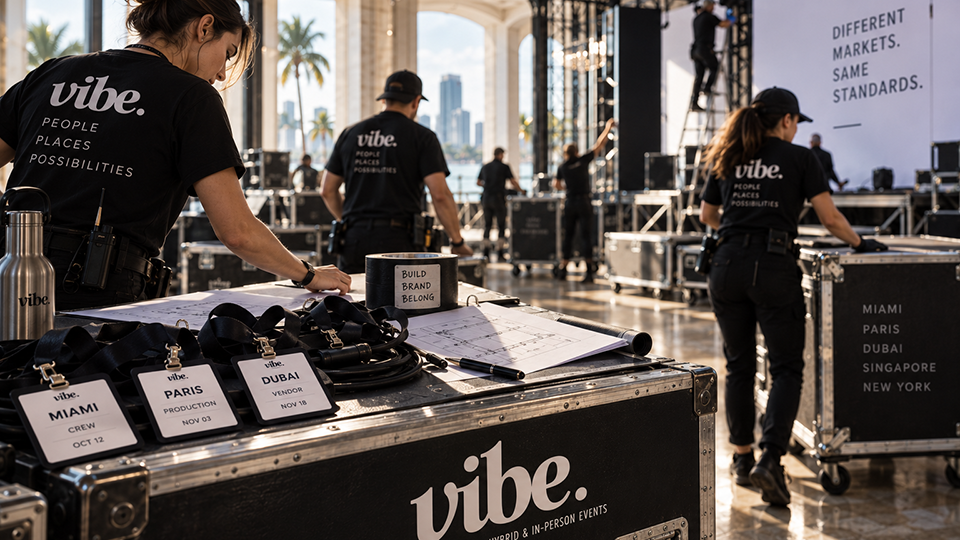
Global brands need something different from an event agency than domestic teams do: real supplier relationships in each market rather than a partner network on a slide, one accountable producer across borders, a brand system that survives translation, contracting and payment that work in every country involved, and measurement defined once so markets can be compared. Reach is easy to claim. Depth is the thing to verify.
What should a global brand look for in an event agency?
Start with a blunt question: in which of my markets have you personally produced something in the last twenty four months?
Most agencies answer a global brief by naming affiliates. Some of those relationships are real and excellent. Some are a directory. The difference does not show up in the pitch. It shows up in February, when a supplier in a market you have never visited stops answering.
Cvent’s survey of 1,650 planners found 24 percent reporting delayed supplier responses. A partner without genuine local depth does not absorb that delay. They forward it to you.
“A global agency is not one that has an office everywhere. It is one that can tell you the name of the person who will be in the room in Sao Paulo, and has worked with them before. Voilà, that is the whole difference, and it takes one question to find out.”
Valerie Bihet, Founder and Executive Producer, VIBE
Why is a global event program harder than a large domestic one?
Because the failure points multiply rather than add.
A domestic program has one legal framework, one currency, one working week, one set of supplier norms and one audience culture. A five market program has five of each, and every handover between them is a place the brand can drift.
The Global Business Travel Association surveyed 539 buyers and suppliers in spring 2026 and found 38 percent of buyers less inclined to host multinational meetings in the United States, and 22 percent had relocated meetings to different markets within three months. Cross-border programs are being rerouted mid-flight, which means your agency’s ability to move a program is now as important as its ability to run one.
The six things global brands should verify before appointing an event agency
- Named suppliers, recently used, in each market. Ask for the supplier, the project and the date. A partner with real depth answers immediately. A partner with a directory offers to check.
- One accountable producer across all markets. Not a local lead per country reporting into an account manager. One person who owns the whole program and is awake for enough of the day to make decisions. Multi-market programs fail in the handovers, so someone must own the handovers. This is the discipline behind running multi-city programs without losing cohesion.
- A brand system that survives translation. Not a logo sheet. Rules for what must be identical in every market and what is deliberately local, decided by you in advance. Without that line drawn, every market improvises and the program becomes five events with a shared font.
- Contracting, currency and payment that actually work. Which entity signs, in which currency, under which country’s law, and how suppliers get paid without your finance team opening a new vendor in every market. This is dull and it is where global programs stall for weeks.
- Measurement defined once, centrally. If each market reports differently you cannot compare them, and a program you cannot compare across markets cannot be optimised or defended. Set the measures centrally before the first market runs. Corporate event KPIs covers which ones travel.
- A documented plan for moving a leg of the program. Given how many buyers are relocating meetings, ask what happens if one market becomes impossible in February. The answer should be a process, not a reassurance.
Should a global brand use one agency or one per market?
One lead agency, with real local execution underneath it, is right for most programs. Local agencies per market are right when the events are genuinely independent and share nothing but a logo.
The test is whether the markets need to add up to something. If leadership will ever ask how the global program performed as a whole, you need one accountable partner and one measurement standard, because five local reports in five formats will never answer that question.
If the events are truly separate, local specialists are cheaper and often better, and there is no reason to pay for coordination you do not need.
How do global brands lose control of an event program?
Almost always the same three ways.
The brief was approved centrally and interpreted locally. Nobody wrote down which elements were non-negotiable, so each market solved its own problems in its own way.
The measurement was agreed after the first market ran. By then the first market’s data is unusable and the comparison is gone for the year.
The escalation path was never named. When something broke at 2am in another time zone, the person who could decide was asleep and unreachable, so somebody made a reasonable local decision that did not match the program.
All three are cheap to prevent and expensive to discover.
Whether you appoint us or another agency, insist on the six checks above, and start with the supplier question. Ask for names and dates in your actual markets. The answer to that one question tells you more than the credentials deck. Our guide to choosing a corporate event agency covers what else belongs in the selection.
Where to start this week
Take your largest multi-market program and write down two things: which elements must be identical in every market, and who can make a binding decision at 2am in the furthest time zone.
If either is unclear, fix that before you brief an agency. Both questions are yours to answer, and no partner can answer them for you.
If you want your global event brief reviewed before it goes to agencies, we will read it and tell you where it will be interpreted differently in each market.
Frequently Asked Questions
What should global brands look for in an event agency?
Real supplier relationships in each market with names and recent dates, one accountable producer across borders, a brand system that defines what is fixed and what is local, workable contracting and payment, measurement defined centrally, and a documented plan for relocating part of the program.
Should a global brand use one event agency or one per market?
One lead agency with real local execution, if the markets need to add up to a single reported program. Local specialists per market are better and cheaper only when the events are genuinely independent of each other.
How do you keep brand consistency across multi-market events?
Decide in advance which elements are non-negotiable in every market and which are deliberately local, and write that down before briefing. Without that line, each market improvises and the program becomes several events sharing a logo.
What is the most common failure in global event programs?
A brief approved centrally and interpreted locally. Measurement agreed after the first market has already run is a close second, because it destroys the comparison for the whole year.
Why are multinational event programs being relocated?
The GBTA found 38 percent of buyers less inclined to host multinational meetings in the United States and 22 percent had relocated meetings to different markets within a three month window, so the ability to move a program has become a selection criterion.
How should a global brand measure events across markets?
Define the measures centrally before the first market runs, use the same definitions everywhere, and require one reporting format. Markets reporting differently cannot be compared, and a program that cannot be compared cannot be defended.