A corporate event workflow is the documented sequence that takes an event from business objective to measured outcome, with an owner and a decision date at every stage. The seven stages are objective, brief, sourcing, design, build, execution and measurement. Most teams have a checklist for the middle three and nothing written for the first and last, which is where events are actually won or lost.
What is a corporate event workflow?
A checklist tells you what to do. A workflow tells you who decides, by when, and what happens if the answer changes.
That difference matters more than it used to. The Global Business Travel Association surveyed 539 buyers and suppliers in spring 2026 and found 56 percent of buyers had changed their meetings or events approach within the previous three months. If your process assumes the plan holds, it is not a workflow. It is a wish with dates on it.
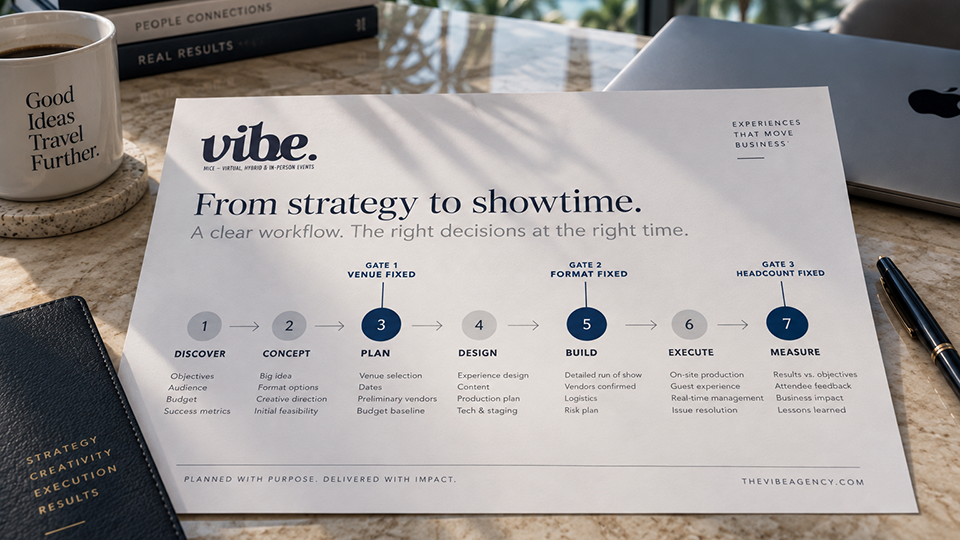
A real workflow names decision points, not just deadlines. By this date the format is fixed. By this date headcount is fixed. Everything before a decision point is open, and everything after it costs money to change.
“A good process does not stop things going wrong. It makes sure the right person hears about it in time to choose. Alors, that is all a workflow is, a list of who gets to decide, and when.”
Valerie Bihet, Founder and Executive Producer, VIBE
The seven stages of a corporate event workflow
- Objective. One sentence naming what the event must change, agreed with whoever funds it, before anything else begins. Owner: the business sponsor. Everything downstream is negotiable. This is not. The reasoning sits in aligning event production with business goals.
- Brief. One page: the objective, the audience, the date range, the budget envelope, the constraint you are most worried about, and the measures of success. Owner: the event lead. A brief longer than a page is usually hiding an unmade decision.
- Sourcing. Venue, production partner, core suppliers. Cvent’s survey of 1,650 planners found 97 percent saying a structured RFP process saves time, and 48 percent now considering non-hotel venues. Owner: the event lead with procurement. Decision date: venue fixed.
- Design. The run of show, the content, the moments that carry the objective, and the capture plan built into the agenda rather than added after. Owner: the producer. Decision date: format fixed.
- Build. Production, logistics, rooming, technical, rehearsal. Owner: the producer. Decision date: headcount fixed. This is the stage most teams document well and it is rarely where programs fail.
- Execution. The event, plus the capture that was designed in stage four actually happening. Owner: the producer on site, with a named person per measure. Fifteen minutes for hosts to log what they heard, while it is fresh.
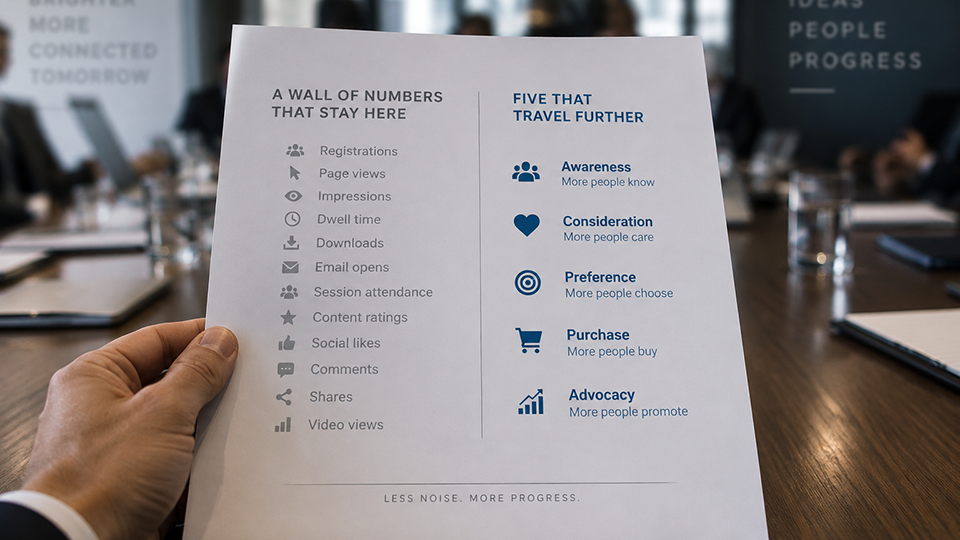
- Measurement and follow-up. The recap, the routing, the sales follow-up, the reporting against the objective from stage one. Owner: the event lead with the business sponsor. Deadline: 30 days, not whenever. Corporate event KPIs covers what to report.
Where do corporate event workflows usually break?
At the two ends, almost never in the middle.
At the front, because the objective was assumed rather than written. Somebody says “we do this every year” and the workflow starts at stage three. Every later decision then gets made on taste instead of purpose, and there is nothing to measure against in stage seven.
At the back, because stage seven has no owner and no deadline. The event ends, the team is exhausted, the next project starts, and the follow-up degrades into an email. The pipeline the event created cools while everyone recovers.
Both failures are free to fix and neither requires a new tool.
How many decision dates should an event workflow have?
Three, and they should be in the calendar before the project starts.
Venue fixed. After this, moving costs money. Format fixed. After this, changing between in-person, hybrid or virtual costs money and quality. Headcount fixed. After this, catering, rooming and production scale are committed.
Naming these three converts every subsequent change from a crisis into a priced choice. It also tells suppliers when they get certainty, which is worth more than it sounds when 24 percent of planners in the Cvent survey report delayed supplier responses.
What should the workflow look like when you run several events a year?
Same seven stages, one shared calendar, and a deliberate order.
Events that share suppliers or audiences should be planned together rather than sequentially. A year-end event and a January kickoff draw on the same venues, the same crews and the same internal team, and planning them apart costs more and rushes the second one. Q4 fills earlier every year, which makes the sequencing decision a financial one.
Run the objective stage for the whole portfolio at once, in budget season. Deciding what all your events are for, in one sitting, exposes the two that exist only because they existed last year.
What should you ask an agency about their workflow?
Ask to see it. Not a timeline, the workflow: stages, owners, decision dates, and what happens when a decision changes after its date.
Ask who owns stage seven in their model. Many agencies hand back a photo gallery and consider the job done. Whether you hire us or someone else, insist that measurement and follow-up appear in the workflow with an owner and a date, because that is the stage that funds next year’s event. Our guide to choosing a corporate event agency covers the rest.
Where to start this week
Take your next event and write the three decision dates in the calendar. Then name the owner of stage seven, out loud, to that person.
That is a workflow. The document can come later.
If you want your event workflow mapped, with owners and decision dates, we will build it with you in one session.
Frequently Asked Questions
What is a corporate event workflow?
The documented sequence taking an event from business objective to measured outcome, with an owner and a decision date at each stage. The seven stages are objective, brief, sourcing, design, build, execution, and measurement with follow-up.
What are the stages of corporate event planning?
Objective, brief, sourcing, design, build, execution, and measurement. Most teams document sourcing, design and build well, and leave the objective and the measurement stages undefined, which is where events lose their business case.
What decision dates should an event workflow include?
Three: venue fixed, format fixed, and headcount fixed. Putting them in the calendar before the project starts turns every later change from a crisis into a priced choice, and tells suppliers when they will get certainty.
Where do event workflows usually break down?
At the beginning and the end. At the beginning when the objective is assumed rather than written, and at the end when follow-up and measurement have no owner and no deadline, so the pipeline created by the event cools.
How do you manage multiple corporate events in one year?
Run the objective stage for the whole portfolio at once during budget season, then plan events that share suppliers or audiences together rather than sequentially, since they compete for the same venues, crews and internal team.
Does an event workflow need special software?
No. It needs named owners and three decision dates in a shared calendar. Tools help teams that already have a workflow, and do nothing for teams that do not.