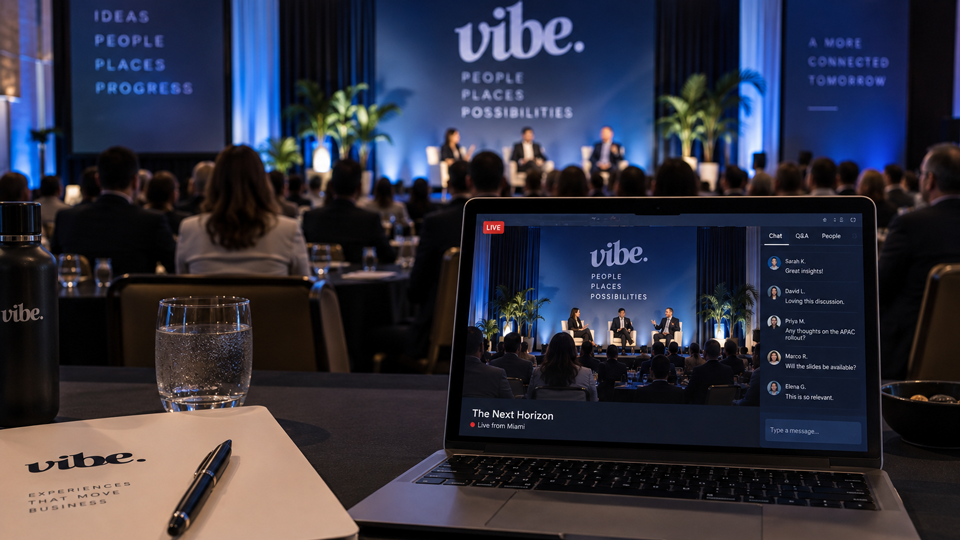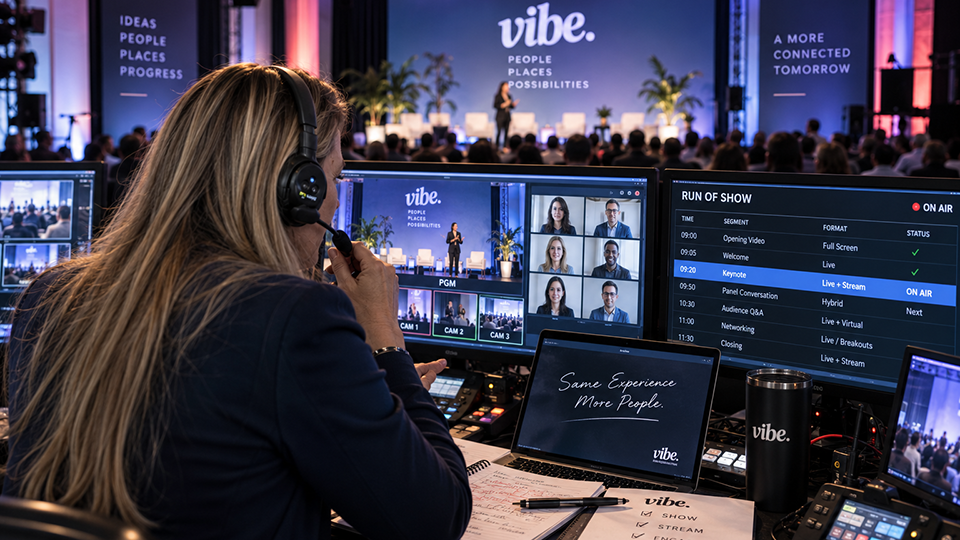
The hybrid event challenges that break corporate programs in 2026 are structural, not technical. You are producing two events at once and most teams budget for one. The nine recurring challenges: two audiences with one program, engagement collapse online, doubled production load, venue bandwidth limits, unequal networking, content that has to work twice, remote presenter quality, fragmented data, and a single team carrying both rooms.
Hybrid is not a livestream attached to a live event. That is a live event with witnesses. Real hybrid means the person at home has an experience designed for them, and that requires a second production plan, a second host, and a second budget line.
Are hybrid events still relevant in 2026?
Yes, and demand for the digital component is growing. PCMA’s 32nd Meetings Market Survey found 28 percent of event professionals expect growth in virtual attendees, up from 15 percent the prior year, with virtual formats emerging as a primary cost-management tactic. GBTA data from April 2026 shows 56 percent of organizations changed their meetings strategy in the previous three months, with 26 percent of those shifts moving toward virtual.
Known fact: virtual and hybrid participation is expanding again, driven largely by cost. Our interpretation: that is exactly why the quality problem is about to get worse. Formats adopted to save money rarely arrive with the budget required to do them properly.
The 9 hybrid event challenges corporate teams face
- Two audiences, one program. The in-room audience wants presence, atmosphere, and each other. The remote audience wants clarity, pace, and a reason not to open email. A single run of show optimized for the room will lose the screen within twenty minutes.
- Engagement collapse online. Attention at home competes with an inbox, a doorbell, and a second monitor. Live audiences give you their bodies. Remote audiences lend you their attention, and they withdraw it silently.
- Doubled production load on one team. Hybrid needs a live director and a broadcast director. It needs someone watching the room and someone watching the stream. Corporate teams routinely assign one person to both, and that person will choose the room every time, because the room is in front of them.
- Venue bandwidth and technical limits. Many beautiful venues have infrastructure built for guest wifi, not for a stable outbound broadcast. Ask for a dedicated hardline, tested upload speeds, and a redundant connection before you fall in love with the space. Cvent’s 2026 sourcing data shows 25 percent of planners already name researching venue specifications as their most challenging task.
- Unequal networking. Networking is the reason most people attend anything. In hybrid, the in-room guests network naturally and the remote guests watch them do it. Structured, hosted, small-group interaction for the remote audience is not a nice addition. It is the difference between attending and observing.
- Content that has to work in two formats. A ninety-minute panel is tolerable in a room and unwatchable on a laptop. Remote programs need shorter segments, tighter visuals, and more frequent change. That means designing the content twice, or designing it once for the harder format.
- Remote presenter quality. One speaker with a laptop camera in a bright window undoes an otherwise excellent production. Ship kits, test in advance, and rehearse remote presenters on the actual platform, not on a different call.
- Fragmented data across two systems. Registration, in-room capture, and platform analytics rarely reconcile cleanly, which is how hybrid events end up with two partial pictures and no single answer about who engaged. Decide before the event which system is the source of truth.
- One budget covering two events. This is the root cause of the other eight. Hybrid is commonly funded as a live event plus a streaming line item. Fund it as two productions sharing content, and most of the quality problems resolve themselves.
“A hybrid event has two front rows. If you only design one of them, you have not saved money. You have paid for an audience you decided to disappoint.”
Valerie Bihet, Founder and CEO, VIBE
Why hybrid is harder than either format alone
A live event has one room, one energy curve, and one set of failure points you can see. A virtual event has one platform and total control over the frame. Hybrid has both, running simultaneously, with different failure modes and a single team.
The difficulty is not technical. Broadcast technology is mature and rentable. The difficulty is attention: yours. Every minute of the show, someone senior must be accountable for the experience of people who are not in the building and cannot interrupt you.
What makes a hybrid event work?
Four things, consistently. A dedicated remote host who is on camera and named in the program. Segments no longer than twenty minutes for the remote feed. Structured small-group interaction for remote guests, hosted rather than optional. And one owner whose only job is the remote experience.
Everything else is refinement.
Should you run hybrid or choose one format?
Choose one format when your objective depends on the room: relationship building, celebration, negotiation, or anything where presence is the product. Run hybrid when reach genuinely serves the objective, most often product education, internal alignment across regions, and partner or customer communities that cannot travel.
Run hybrid badly and you get a diluted live event plus a poor broadcast. Two compromises rarely add up to one win.
Where to start this week
Look at your next hybrid event and answer one question: who owns the remote audience on show day, by name, and is that their only job? If the answer is the same person running the room, you do not yet have a hybrid event. You have a live event with a camera in the back.
We produce live, hybrid, and virtual programs, and we staff hybrid with a separate remote lead for exactly this reason. The technology is the cheap part. The accountability is what costs money, and it is the only thing that reliably shows up in the results.
If you have a hybrid event coming and you are not sure the remote half is properly resourced, send us the run of show and we will tell you where it will break.
Pressure-Test Your Hybrid Plan
Frequently Asked Questions
What are the biggest hybrid event challenges?
Two audiences served by one program, remote engagement collapse, doubled production load, venue bandwidth limits, unequal networking access, content that must work in two formats, remote presenter quality, fragmented data across systems, and a single budget funding two productions.
Why are hybrid events hard to run?
Because you are producing two events simultaneously for two audiences with different needs, usually with one team and one budget. The in-room audience needs atmosphere and interaction. The remote audience needs pace, clarity, and structured participation. Optimizing for one audience loses the other.
Are hybrid events still worth it in 2026?
Yes when reach serves the objective, particularly for product education, multi-region internal alignment, and communities that cannot travel. Industry data shows 28 percent of event professionals expect virtual attendance to grow, up from 15 percent the prior year. Hybrid is less effective when the objective depends on physical presence.
How much more does a hybrid event cost?
Budget hybrid as two productions sharing content rather than a live event plus a streaming fee. The additional cost typically covers broadcast direction, a dedicated remote host, platform licensing, connectivity redundancy, and remote presenter support.
How do you keep remote attendees engaged at a hybrid event?
Assign a named remote host who appears on camera, keep segments under twenty minutes, provide hosted small-group interaction rather than an optional chat, and give the remote audience at least one moment the in-room audience does not get.
What internet connection does a hybrid event need?
A dedicated hardline with tested upload capacity and a redundant secondary connection, confirmed by an on-site technical survey. Venue guest wifi is not sufficient for a reliable outbound broadcast, and this should be verified before the venue contract is signed.