The best virtual event services for enterprise town halls do three jobs at once. They stream reliably to every employee. They make your leaders credible on camera. And afterward, they prove that people understood the message and acted on it. A platform does the first job. A production partner does all three. Here’s how to tell which one you’re buying.
A town hall isn’t a webinar with a bigger audience. It’s the one moment each quarter when thousands of employees decide whether they believe leadership. If the stream freezes during the CEO’s opening, nobody sees a technical glitch. They see a company that wasn’t ready.
What are virtual event services for enterprise town halls?
Virtual event services are the technology and the people that put a live leadership broadcast in front of a distributed workforce. They come in three forms, and most buying mistakes start when they get confused.
- Self-service webcast platforms. Streaming, registration, Q&A and replay in one login. Your team runs the show.
- AV and broadcast production houses. Cameras, lighting, audio and a control room. Strong on the signal, lighter on content and outcomes.
- Full-service production partners. Strategy, speaker preparation, live direction and post-event reporting, all run on the platform your IT team already approves.
None of the three is wrong. The right choice depends on what your internal team can realistically own on the day.
The 7 things the best virtual event services deliver
Whether you hire us or someone else, ask every provider on your shortlist about these seven. We learned each one in a control room, not a sales meeting.
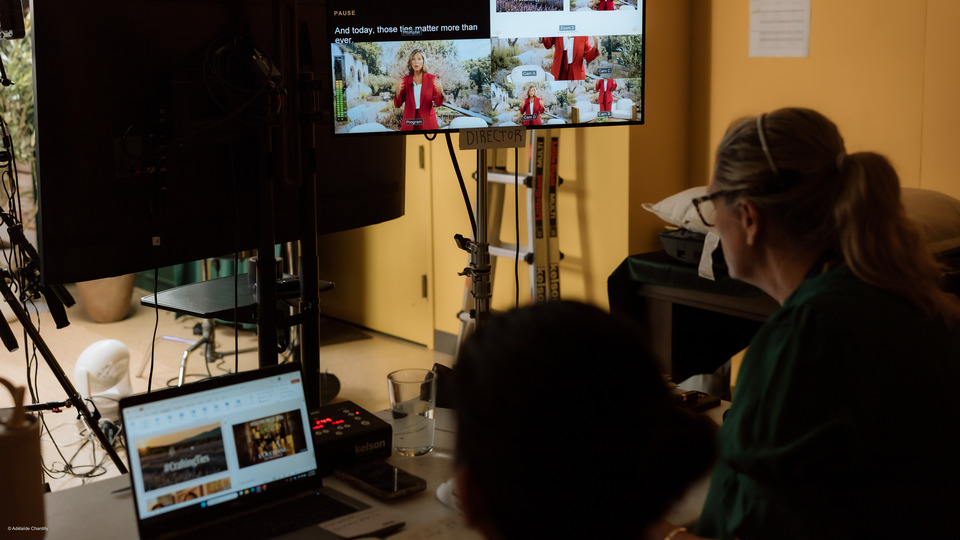
- One named person directs the live broadcast. Not a shared inbox, but a person whose only job during the show is to keep technical problems away from leadership. Ask: who sits in the control room, and who is in the speaker’s ear?
- Redundancy you can describe in one breath. A backup encoder, a second internet path, and a failover stream that switches over in seconds. Ask: what happens at minute 14 if the main feed drops?
- Executive-ready production. Multi-camera switching, lighting set for the room, a teleprompter, and a full technical rehearsal with the actual speakers. Credibility on camera is built in rehearsal, not on the day.
- A run of show written for the remote audience. Not the in-room agenda with a camera added. L’Occitane’s CxC is the conference that kicks off the Holiday Season for Beauty Advisors across the United States and Canada. For CxC, 300 people joined online over two days, with their own run of show, live moderation, dynamic camera switching and remote product storytelling labs. Ask: who owns the online audience, and what’s in their script?
- Security that covers every audience, not just the room. Single sign-on, encrypted streams and role-based access. Porsche combined its Investor and Importer Conferences into one four-day hybrid program in Miami. On the confidential day, guests on site went through security staff and a device check-in, and digital guests got equivalent restricted access. A leak from a laptop is still a leak.
- Language and culture handled before the stream starts. Live captions, translation, and replay for the regions that were asleep. When Shiseido gathered more than 100 executives in Dubai for the first time, we coordinated translators for attendees traveling from Japan and briefed every guest on local customs during Ramadan. A global town hall is a communication problem first and a streaming problem second.
- A measurement plan written before the show. Decide what employees should understand, decide or do differently afterward, then capture the data that proves it. A provider who only talks about measurement after the event is reporting, not measuring.
Platform or partner: which does your town hall need?
Choose a self-service platform when your communications team has in-house AV staff, the format repeats every month, and the stakes are routine. Choose a production partner when the CEO is on camera, the message carries change such as a reorganization, a merger or a new strategy, or the audience spans continents.
The test is simple. If the broadcast fails, whose credibility pays for it? If the answer is leadership’s, you need a partner who owns the outcome, not a login. That’s what 360+1 is built for. Most agencies offer 360. VIBE delivers 360+1. The 360 is full-service strategy, creative, production, logistics, technology, and global execution, all under one roof, one team, and one point of accountability. The +1 is the human element: the instinct, empathy, and cultural fluency that transform a well-executed event into an experience people remember.
What about employees who never sit at a desk?
A virtual town hall assumes everyone has a screen and an uninterrupted hour. Plant floors, boutiques and distribution centers have neither, so plan a second way to deliver the message.
Danone North America’s plant in Minster, Ohio, needed to reach up to 500 employees across day and night shifts over three days, inside 30-minute breaks. Our answer was senior leadership on site, one tent steps from the plant entrance, and every touchpoint designed to fit into a single break. Danone confirmed a second Minster program for April 2027 before the first had closed out.
The lesson for town hall planners: stream to the desks, and bring leadership to the floor.
How do you measure the ROI of a virtual town hall?
Peak viewership tells you how many people opened the stream, not whether the message landed. Measure the town hall the way you’d measure any business investment, with numbers that make sense to the people who fund it.
- Live attendance against invited headcount, by region and function, so you can see who the message didn’t reach.
- Online participation rate: the share of remote viewers who asked a question, voted or responded at least once.
- Day-over-day or session-over-session retention, which shows whether the remote audience came back.
- Satisfaction or NPS, from a short pulse survey sent the same day.
- Follow-through on the business action the town hall asked for, tracked at 30 days and beyond.
Here’s what that looks like on a real program. L’Occitane’s CxC reported an NPS of +68, 90% day-over-day virtual retention, and an 80% interactive participation rate online. The fifth number, the Holiday Season KPI uplift, was still being measured when the case study was published. That’s the honest picture, and it’s the point: you know engagement within a day, business impact takes a season, and both belong in the plan from the start.
What hybrid and virtual leadership moments have taught us
Since 2004, The VIBE Agency has produced live, hybrid, and virtual programs for audiences ranging from a single boardroom to an entire continent. The same pattern keeps showing up. Remote attendees decide within minutes whether they’re guests or an afterthought, and the run of show makes that decision, not the camera.
"Alors, here is the question I ask every executive before a town hall: if your people stop listening at minute ten, what do they hear at minute eleven? Design for that moment, not for your opening slide."
Valérie Bihet, Founder and CEO, The VIBE Agency
The bottom line
Employees judge a town hall by what they do the following week, not by how polished the stream looked. The best virtual event services give you three things a platform alone can’t: one person accountable for the live moment, a show designed for every audience that’s watching and for the employees who can’t, and a measurement plan that connects the broadcast to business results.
The VIBE Agency has produced 2,000+ events and was recognized on the 2026 Inc. 5000 list, ranking #229 in Business & Corporate Services. If your 2027 town hall is on the calendar, now is the time to lock in your production team and rehearsal dates.
Planning a 2027 town hall or leadership broadcast? Talk to a VIBE producer about your run of show.